

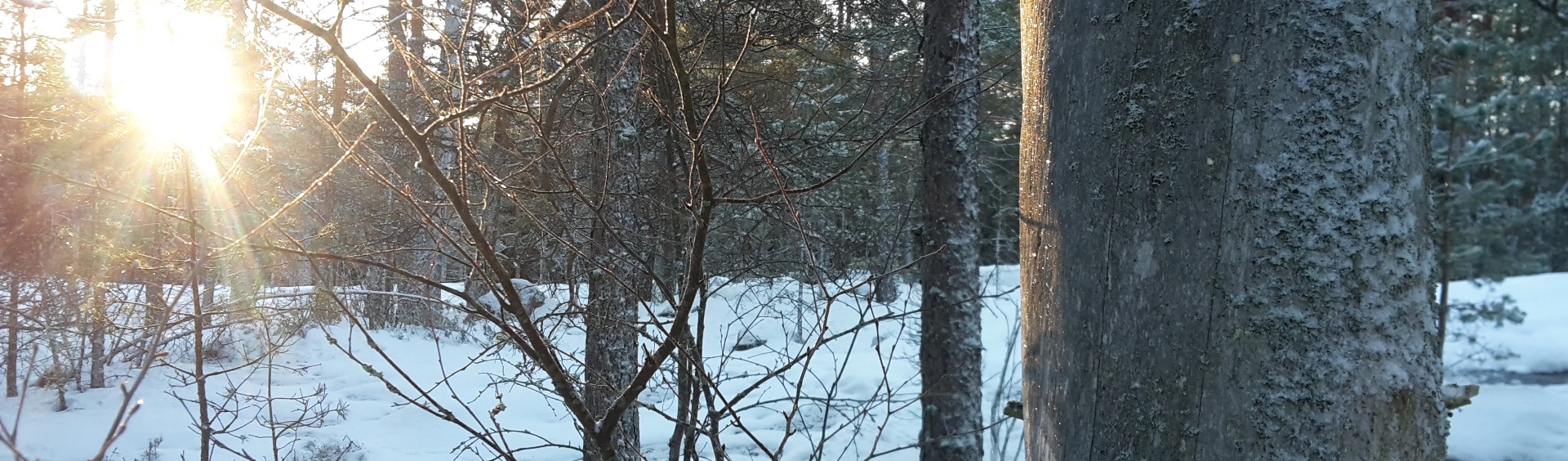
In the forest, the frost gently nips at my cheeks. A woodpecker taps somewhere nearby, though I can’t see it. My gaze meets the sun peeking through pine branches and lingers there. The light comes in and touches. Suddenly there is space to breathe, to exhale. My feet feel steady against the bedrock. The branches, the forest, the snow, the light and shadows are present all around, somehow more alive. Like waking from a dream, able for a moment to simply be. In the background, a faint trace — a felt sense of some deeper meaning.
Sometimes in life there may come moments when something more opens up: a sense of presence, a feeling of connection, a hint of something that calls. In some way, the experience of oneself and the world feels different. We may understand and describe this in different ways. Some of us may feel that this has to do with a landscape of spirituality or the sacred. Such landscapes can also help make sense of the world and offer guidance for life. They may speak of what is important, or invite us to follow a kind of spiritual path.
I consider it important that there is space for spirituality in therapy as well, if the client so wishes. My own therapeutic work also includes elements that could be described as psycho-spiritual. Here I explore these aspects of therapy in more detail. In the text that follows, I will write more about the interface between a spiritual path and psychological healing.
Bringing the spiritual dimension into therapy
For many people, the spiritual dimension is meaningful — for some, it is even central to life. I consider it important that there is space for this in therapy, and that these aspects of being human do not need to be hidden. These themes, too, can be shared, explored, and reflected upon in therapy. At the same time, there is equally space for those for whom spirituality does not feel relevant, or who prefer to keep it outside the therapeutic work.
In therapy, spirituality is always approached from the client’s own perspective. Naturally, as a therapist I am more familiar with some spiritual traditions than others. My strongest connection is with the Buddhist meditation path, shamanic approaches, and Christianity. What matters most, however, is that I recognize the possible significance of spirituality in a person’s life. I am drawn to the idea that different traditions can be seen like fingers pointing to the moon — different ways of referring to something that is difficult to put into words.
Different kinds of spiritual experiences are also welcome in therapy — I do not shy away from them. These may include experiences of deeper presence, a sense of connection to something greater than oneself, or moments when life or the sense of self appears wider than usual. For some, these experiences may also include a sense of guidance, a felt presence of those who have passed, or encounters with the spiritual realm. It can be meaningful to gently explore such experiences in therapy — whether they are understood as “real” in some way, or as the psyche’s way of reaching its deeper layers. Spirituality can also be an important resource for the client. It may offer support both in everyday life and in therapy, especially when something difficult arises.

Questions of meaning can also be a valuable part of therapy: the sense of purpose in life, the feeling of meaninglessness, or reflections on what is truly important and valuable. Such themes often emerge at times of crisis and are closely connected to our well-being. In his book Uupumuksesta takaisin elämään, Juhani Mattila suggests that for a person suffering from burnout, rest alone is often not enough to restore their energy. What is needed is something that awakens enthusiasm and vitality: experiences of meaning.
The spiritual dimension in the therapeutic process
A spiritual dimension may also be present in the therapeutic process itself and support it. Core Process, the modality I practice, is grounded not only in Western psychotherapeutic understanding but also in wisdom rooted in Buddhism. One of its foundations is trust in the wholeness and goodness that can be found within each person — an inner movement toward health, growth, and well-being.
Something similar to meditation can take place in therapy. We notice what is present and open ourselves to meeting and accepting it. Certain ways in which we habitually construct ourselves may begin to soften. Instead of being completely immersed in everything happening within us — fully believing our thoughts and identifying with our feelings — there is the possibility of observing them from a little distance. We may loosen our struggle against what is — a struggle that often holds our difficulties together as one tight knot. This creates space to breathe. There is room to see more clearly, to respond differently, and to relax. Perhaps, for a moment, there is simply the possibility of to be — resting in being together. It is often in such moments that something begins to shift and gradually heal.
I also feel that there is something in therapy that is not entirely within our control. We can do much: explore, sense, and remain present. Yet therapy cannot be fully planned or engineered. Space for change opens when we are willing to stay with the not-knowing. Sometimes there are moments when all we can do is simply be present together with what is difficult — to pause and let the experience be seen. And sometimes, unexpectedly, space opens to breathe. What may be essential is that something other than our own effort and need for control is also allowed to do its work. This, too, might be understood as a spiritual dimension.
References:
Mattila, Juhani (2021): Uupumuksesta takaisin elämään. Helsinki: Kirjapaja.
Read also what else I have written related to the borderlands between the spiritual and the psychological:
The relationship of meditation to psychological healing
Spirituality without bypassing our humanity